
Qu’est-ce qui provoque réellement une sensation de sécheresse des lèvres ?
Understanding Lip Dryness
Dry lips are often misunderstood.
They are rarely a sign of dehydration alone, and rarely solved by “more balm.”
Most of the time, dry lips are about structure, exposure, and irritation.
Understanding this changes how you care for them.
Lips are built differently than skin
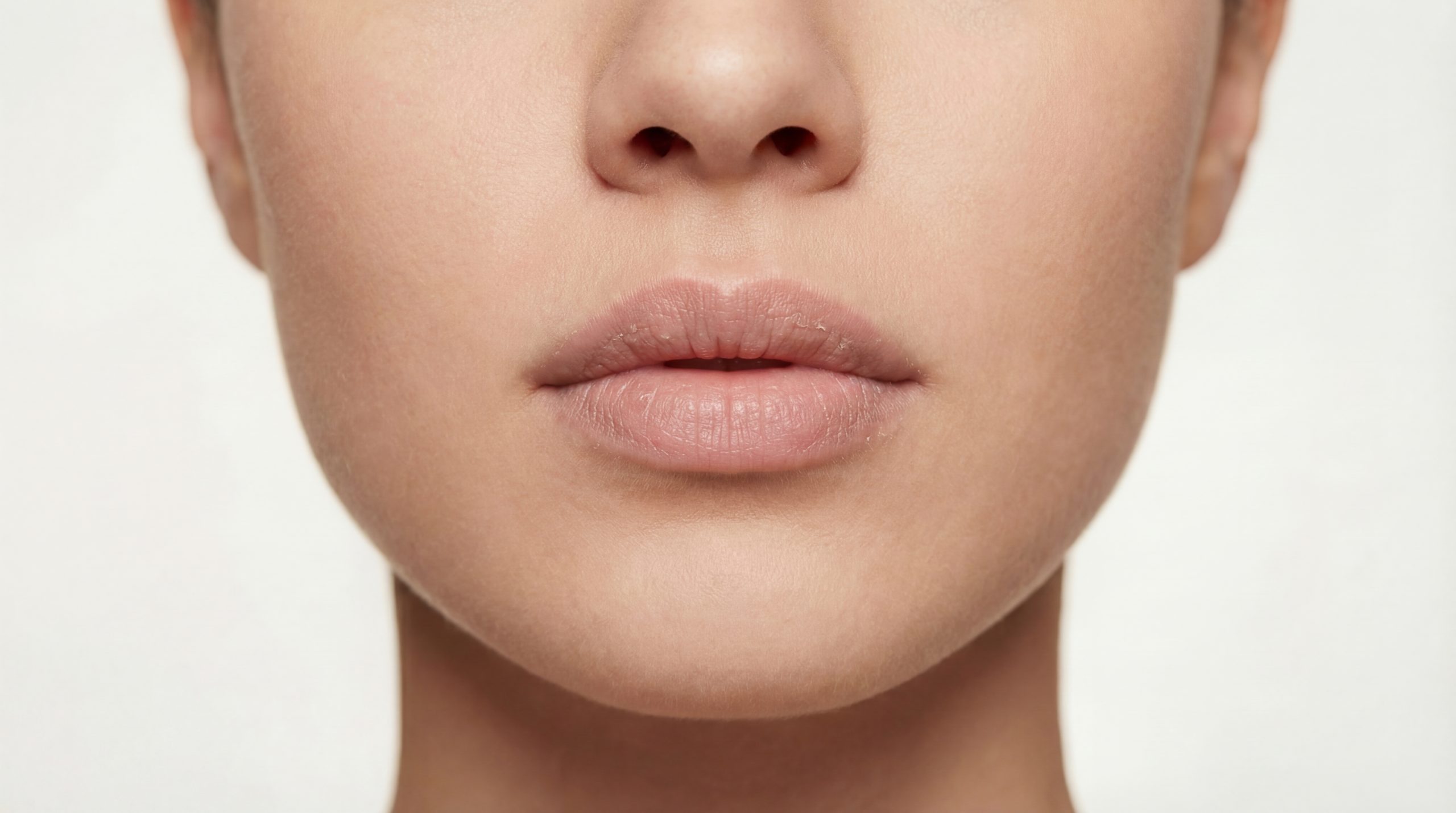
The surface of the lips (the vermilion) is not the same as facial skin.
Facial skin has around 15–16 cell layers.
Lips have only 3–5 cell layers.
This difference is fundamental.
Lips are thinner, more permeable, and structurally less equipped to retain moisture. They also contain no sweat glandsand very few oil-producing glands, which means they do not create their own protective film.
As a result, lips are naturally more exposed and more reactive.
Dry lips are usually about water loss, not lack of water
Many people notice that their lips feel dry even when they drink enough water. This is not a contradiction.
In most cases, dryness is caused by water escaping too quickly from the surface, a process known as transepidermal water loss.
Because the lip surface is thin and poorly protected, moisture evaporates faster than on other areas of the face. The sensation of dryness is therefore often external rather than internal.
Why lips lose moisture so easily
Several everyday factors increase surface evaporation:
dry or cold air
wind
indoor heating or air conditioning
altitude or flights
This explains why dry lips in winter are so common, and why dryness can appear suddenly after environmental changes.
Lips are exposed at all times, and they respond quickly.
When dryness is actually irritation
One of the most common reasons lips feel dry is not dryness itself, but irritation.
Certain habits or ingredients can disturb the lip surface:
frequent lip licking
strong fragrances or flavours
essential oils
stimulating or tingling formulas
excessive exfoliation
When the surface is irritated, the lip barrier weakens. Water escapes more easily, and the discomfort is perceived as dryness.
Understanding the difference between irritated lips and dry lips is essential, because irritation does not respond well to stimulation; it responds to calm and protection.
A note on the sun
Sun exposure can contribute to lip discomfort in specific situations, such as prolonged outdoor exposure or altitude. However, in everyday life, it is rarely the main reason lips feel dry.
Air, behaviour, and surface irritation play a much larger role.
Other factors
Sometimes, persistent dryness reflects broader changes, such as hormonal shifts, nutritional imbalances, or certain medications. These factors do not need to be assumed, but they help explain why dryness can persist even with good care.
What actually helps dry lips
Because lips lose water easily, they benefit most from protective, lipid-rich care rather than water-based formulas.
The most suitable products are those that:
form a soft protective film to slow evaporation
compensate for the lack of natural oils
support comfort without stimulating the surface
In practice, this means anhydrous or low-water formulas built around oils, waxes and butters.
Certain ingredients are particularly well suited to lip care. Ricinus communis (castor) oil, for example, is naturally viscous and highly film-forming. It adheres well to the lip surface, helping to limit moisture loss while maintaining flexibility and comfort. Plant waxes and fatty esters play a similar role by reinforcing surface protection without occlusion discomfort.
When lips feel sensitive or reactive, formulas designed to stimulate, tingle or plump can feel uncomfortable, even if they perform well at other times. In those moments, a more protective, neutral care is often better tolerated.
Lip care works best when it adapts to how lips feel not when it follows a single routine.
The essential idea
Dry lips are not a failure of hydration or effort.
They are the result of a very thin structure, constant exposure, and a surface that reacts quickly to its environment.
Caring for lips is less about doing more, and more about mieux protéger.